
MCCC Release Paths
Maui Community Correctional Center is Hawaiʻi’s principal correctional facility in Maui County. The Department of Corrections and Rehabilitation, or DCR, operates it as a community correctional center. That role is broader than a typical county jail. MCCC holds pretrial detainees and people serving very short sentences, while also working with sentenced felons and parole violators who are expected to return to Maui. The legal reason for custody determines the path out.
A person may leave MCCC on bail, bond, dismissal, time served, probation, parole, release to appear, supervised release, or sentence discharge. Each term has a distinct meaning. Parole is community release under Hawaiʻi Paroling Authority control. Probation comes from the Judiciary. Discharge may mark an end to confinement or a later end to sentence liability, so the full record matters. The DCR release checklist also recognizes transfer, extradition, deportation, and release to Hawaiʻi State Hospital. Those events end the MCCC placement but do not prove an ordinary return to the community.
| MCCC departure | What it can mean | Best confirmation |
|---|---|---|
| Bail, dismissal, time served | Community release tied to a court event | DCR release record plus eCourt |
| Parole or supervised release | Community movement under stated conditions | DCR, SAVIN, and HPA when parole applies |
| Transfer or extradition | Custody continues with another place or authority | DCR 8219 and receiving agency |
| Discharge | Status depends on the record’s exact label | DCR and any HPA final-discharge record |
Confirm an MCCC Release
Start with Hawaiʻi SAVIN, DCR’s public custody and parole information route. Follow its VINELink search, select Hawaiʻi, and enter the full legal name or known identifier. Read the result literally. A current-custody result is not a release record. A released or parole status is useful, but it may not disclose the release type or remain available as a permanent history. No result is inconclusive.
Next, call MCCC or the Maui Intake Service Center and ask whether the person remains at MCCC, departed to the community, or transferred. Then compare the matching case through the Hawaiʻi Judiciary court-record gateway. A bail order, dismissal, probation sentence, or time-served disposition explains legal authority. It does not establish the precise moment DCR completed its identity, document, hold, and property checks.
- Search the exact name in Hawaiʻi SAVIN and save the status wording and time checked.
- Call MCCC or MISC with the name and approximate custody date. Ask whether the departure was community release or transfer.
- Match the Maui court case by case number and review the release order, judgment, or disposition.
- Request DCR 8219 and the final Offendertrak entry when the exact release time and type are needed.
MCCC Release Records
The executed DCR 8219 checklist is the strongest source for the physical release event. DCR procedure COR.16.02 requires staff to verify identity and release authority, check charges and criminal numbers, screen pending charges and detention documents, and record the release type. Supporting documents may include a judgment or record of proceedings. The form also contains sensitive identity, victim, health, and sponsor details that may be withheld or redacted.
For an older or disputed MCCC release, use the OIP government-record request form and send it to DCR, not OIP. Identify the full name, any known DCR number, the MCCC custody period, and the records sought. Ask for the public portions of DCR 8219, actual date and time, release type, releasing facility, destination category, supporting document type, and final Offendertrak status. Electronic delivery can keep the request narrow.
Hawaiʻi’s UIPA process permits redaction of exempt matter while allowing segregable public portions to be produced. The request guidance says an agency normally responds within ten business days, with up to twenty in extenuating circumstances. Those periods describe the response process, not a promise that every requested record will be delivered by that day. The broader Maui County released-inmate search explains how a DCR release record fits with court and parole sources.
MCCC Contacts and Intake
Use the facility for current status and the intake or records route for durable proof. A concise question is best: ask whether the named person is still at MCCC, left to the community, or transferred to another agency or facility. Staff may not disclose private destination or sponsor data. Ask which public record can confirm the release type and date.
600 Waiale Drive
Wailuku, HI 96793
808-243-5101
Visitation: 808-243-5861
Fax: 808-244-0128
MCCC’s official page gives the core facility contact. DCR’s published numbers also identify the Maui Intake Service Center at 1797 Wili Pa Loop #1, Wailuku, HI 96793, phone 808-243-5008 and fax 808-243-5108. MISC is especially useful for intake, records, furlough, and transition questions tied to an MCCC custody episode.
Phone confirmation can resolve a current ambiguity, but a written agency record is more durable. Note the unit contacted, date, and time. If staff describe a transfer, ask for the receiving category rather than assuming release. If they describe parole, compare HPA’s decision with DCR’s actual release entry.
MCCC Property and Processing
DCR release procedure shows why an order and a gate event can occur at different times. Staff must match the person with the supporting authority, check for holds or pending matters, collect state-issued items, and return personal property and money as soon as practical. Offendertrak is then updated, which supports the SAVIN notification process. No official fixed MCCC gate-release hour was found.
A court may authorize release while another case, extradition request, federal detainer, or receiving-agency hold prevents a normal community departure. “Detainer” means a request or legal basis for another authority to maintain custody. The right question is not merely when the order was signed. Ask when DCR executed the release and which release category it recorded.
- Release authority
- The court, parole, or other document that permits DCR to act.
- Actual release
- The completed facility event recorded after required checks.
- Transfer
- A move between institutions or authorities while custody continues.
- Final discharge
- The end of the applicable sentence or parole authority, when the record clearly says so.
Note: The court order is strongest for legal authority, while the executed DCR record is strongest for the physical departure from MCCC.
MCCC’s Mixed Release Role
MCCC is not merely a local pretrial jail. DCR says community correctional centers hold pretrial detainees and very short misdemeanor sentences, yet MCCC also provides reintegration services to sentenced felons and parole violators who will be released on Maui. This mixed role changes how a record must be read. A short pretrial stay may end through bail or a court order. A transitional felony placement may end in parole, furlough, a program move, or another transfer.
The official MCCC facility page documents its address, statewide role, and work with people expected to return to Maui.
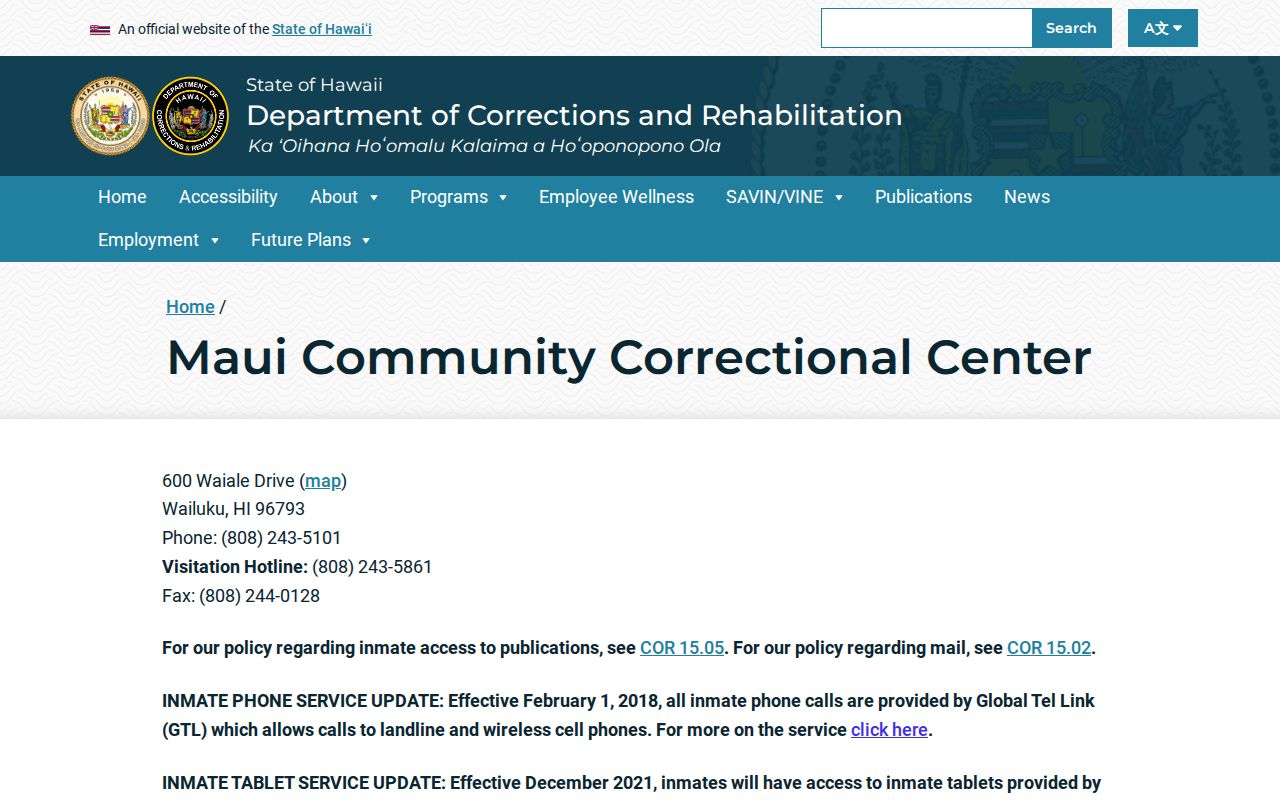
The captured state page reinforces why a Maui Community Correctional Center departure must be classified as release, parole, program movement, or transfer.
Hawaiʻi’s three state prisons are on Oʻahu. A person sentenced in Maui can move to Hālawa, Waiawa, or the Women’s Community Correctional Center. Some Hawaiʻi prisoners are held at the contracted Saguaro facility in Arizona. A later return to MCCC may bring a person closer to an approved Maui plan, but it does not prove that the sentence or DCR custody ended.
The return-to-island policy helps explain these moves. Custody location, Maui case origin, and planned parole county can differ. Statewide SAVIN, HPA, and DCR records should follow the person across islands. The release type remains the key fact.
Getting Home After MCCC Release
DCR’s FY2024 reporting documents MCCC reentry and transportation work, including bus-pass assistance. It is useful local context, not a guaranteed benefit. A bus pass, route, pickup time, or ride should never be assumed for a specific person. Confirm plans with MCCC, MISC, or the named program before departure.
Supervised release to a program or sponsor is a recognized DCR category. It can place someone in the community while legal control continues. Private sponsor contact should not be sought without a valid reason. A public-record request can ask for the destination category and release status while allowing private contact details to be redacted.
For parole, HPA may require an approved plan before actual release. An approval and a gate departure are separate events. When family transportation depends on timing, compare the HPA outcome with the latest SAVIN status and direct DCR confirmation rather than relying on the hearing date alone.
MCCC Release Source Conflicts
Different dates may describe different stages. A judge can sign an order, the clerk can enter it later, DCR can receive and execute it after required checks, and SAVIN can notify after the status update. Those timestamps need labels. Choosing the first or last without context can create a false conflict.
If two sources claim to describe the same event and disagree, contact the record owner. MCCC or DCR should address its release timestamp. The Judiciary clerk owns the docket and order. HPA owns the parole decision and discharge history. Preserve both versions and any agency correction response.
A SAVIN result is a public-facing status channel, not a certified release document. An eCourt order establishes legal action, not always physical processing. The DCR checklist joins the identity, authority, holds, release type, and executed event. Together, those sources can show whether someone returned to Maui, remained supervised, or simply moved out of MCCC.