
Understanding Maui County Releases
Hawaiʻi runs Maui’s main jail through the Department of Corrections and Rehabilitation. Maui Community Correctional Center holds pretrial detainees and short-term sentences while also serving transitional felons and parole violators. That mixed role makes the word “released” easy to misread. Leaving MCCC can mean return to the community, but it can also mean transfer to a state prison, extradition, deportation, hospital placement, or movement into another program.
A current custody search usually stops showing someone after the reporting agency changes the status. The underlying trail remains in DCR’s operational record, the court case, and, when parole applies, Hawaiʻi Paroling Authority records. The sound conclusion is narrow: identify the facility departure, release type, and any continuing authority. “No longer at MCCC” is safer than “free” until those facts align.
Maui County Release Types
DCR form 8219 separates community-facing release categories from departures that continue custody elsewhere. The same date can carry very different consequences. Bail, probation, parole, and discharge should never be used as synonyms.
| Release type | Meaning | Next verification source |
|---|---|---|
| Bail, bond, or release to appear | Pretrial release while the case continues. | eCourt and DCR’s executed release entry |
| Dismissed or time served | A case disposition or satisfied custodial part for the specified matter. | Court judgment plus DCR release record |
| Probation or supervised release | Community release under court-set terms. | Judiciary case and probation division |
| Parole | Release under HPA’s continuing custody, control, and supervision. | HPA, SAVIN, and DCR actual release |
| Discharge | An ending event whose scope must be read from the record. | DCR or HPA final-discharge document |
| Transfer, extradition, deportation, or HSH | Departure from one DCR setting without ordinary community release. | Receiving agency, court, BOP, ICE, or hospital authority |
A “time served” entry applies to the identified case and can coexist with another charge or hold. HRS §706-671 makes qualifying presentence detention credit relevant, while concurrent or consecutive terms and other custody can change the result.
Maui County Release Record Fields
The best official inventory comes from DCR 8219 in DCR’s release procedure. It is an operational control record, not a simple roster row. Staff confirm identity, legal authority, pending matters, holds, release type, and the supporting judgment or record of proceedings.
| Field | What it shows |
|---|---|
| Name, alias, physical identifiers, and photo | Wrong-person safeguards tied to the custody episode. |
| Actual release date and time | When facility processing was completed. |
| Release type | The category, such as parole, probation, bail, discharge, time served, or transfer. |
| Releasing facility | The DCR location responsible for the event. |
| Supporting document | The judgment or other authority staff used. |
| Charges, criminal numbers, and bail amount | Case connections and release checks. |
| Holds, detainment documents, and pending charges | Reasons one order may not lead to immediate community release. |
| Destination category and remarks | Whether the departure was parole, program, sponsor, transfer, or another route, subject to redaction. |
| Offendertrak status entry | The internal custody-status update that also supports SAVIN reporting. |
Sensitive fields may be removed from a public copy. Social Security numbers, full birth data, victim information, medical destinations, sponsor contacts, and investigative details can raise privacy or safety concerns. Redaction does not automatically make the actual release date, type, or facility unavailable.
How Maui County Releases Process
DCR policy supplies the most concrete Maui release-logistics evidence. Staff match the person with release authority, review holds and pending charges, return personal property and money as soon as practical, collect state-issued items, and update Offendertrak immediately after release. A phone fallback supports notification when the system is unavailable.
No official fixed MCCC gate-release time was found. A judge’s order can arrive before identity checks, supporting documents, or another hold is resolved. For that reason, the signed order date, clerk-entry date, DCR execution time, and SAVIN update should remain separately labeled. The sequence may span more than one day without any source being wrong.
Note: Ask for the actual facility timestamp instead of estimating release from the time a court order appeared online.
Maui Release Property and Corrections
COR.16.02 requires personal items and money to be returned upon release or as soon as practical. The checklist also accounts for state property and identity controls. Questions about items from a recent MCCC episode should go to the facility or MISC with enough booking detail to identify the episode.
A person who finds an error in their own government release status has a formal path. Hawaiʻi’s personal-record provisions in HRS chapter 92F, especially §§92F-24 and 92F-25, address correction or amendment and review. State the exact disputed date or status and provide the supporting court or release document through the agency’s secure method.
Request Maui County Release Records
Use the OIP Request to Access a Government Record form, then send it to the record owner. OIP oversees Hawaiʻi’s public-records law but does not hold MCCC, HPA, court, or police operational files.
- Identify the full name, known DCR or case number, MCCC custody, and approximate dates.
- Ask DCR for releasable portions of DCR 8219, the actual release timestamp, release type, releasing facility, destination category, supporting document type, final Offendertrak entry, and sentence computation when relevant.
- Ask HPA separately for a parole hearing outcome, releasable decision, actual parole-release date, or final-discharge date.
- Choose inspection or electronic copies. Request redaction of exempt details rather than withholding of material that can be separated.
- Ask for a fee estimate and retain the agency response, source, and date.
OIP guidance says an agency normally responds within ten business days and may take up to twenty in extenuating circumstances. A response can be an acknowledgment or notice rather than completed production. Published processing caps are $5 per fifteen minutes of search and $7.50 per fifteen minutes of review and segregation, plus lawful copy or delivery costs.
MCCC, 600 Waiale Drive, Wailuku, HI 96793, 808-243-5101
MISC, 1797 Wili Pa Loop #1, Wailuku, HI 96793, 808-243-5008
Maui Release Records and Expungement
Hawaiʻi’s Uniform Information Practices Act, HRS chapter 92F, governs access, exemptions, personal-record rights, and correction procedures. An online roster window does not define retention. DCR, HPA, the Judiciary, and police maintain different files under their own schedules and restrictions, so older release proof generally requires a focused request.
The Hawaiʻi Criminal Justice Data Center, not MCCC, administers the state expungement process. Expungement is not the same as release and must not be described as automatic erasure of every facility record, docket entry, official news item, or independently held image. Eligibility and effect depend on the legal basis and case result.
HRS §353-62(b)(2) creates a separate parole transparency duty. Within thirty days after a parole release hearing, HPA must make the prisoner’s name and approved or denied result public. That result does not prove actual departure, which still requires the facility status or release record.
Find Maui County Released Inmates
The search begins with the custody system. A Maui arrest may lead from police holding to MCCC. A felony sentence can lead to an Oʻahu prison or Saguaro in Arizona. A federal sentence belongs in BOP records, while immigration custody belongs with ICE. A court case can supply the legal basis even when no public custody result appears. Questions about a future state sentence milestone require the separate Maui County projected release date process.
- Search the exact legal name in Hawaiʻi SAVIN and record the literal status, reporting agency, and time checked.
- For a recent MCCC case, call MCCC or MISC and ask whether the person remains there, entered the community, or transferred.
- Open the matching eCourt case. Look for bail, supervised release, dismissal, judgment, sentence, probation, commitment, or revocation.
- For a state-prison sentence, compare SAVIN status with HPA’s minimum-term, parole decision, and actual-release records.
- Use BOP or ICE when federal or immigration custody is involved.
- Submit a narrow UIPA request when a historical or ambiguous event cannot be resolved online.
Why is the name gone? Current-custody tools are designed to show present status, not a permanent release history. A no-result can reflect a variant spelling, transfer, older episode, another system, sealed or expunged material, or data no longer displayed. Never translate it directly into release.
Maui Released Inmate SAVIN Search
DCR’s public “Locate an Offender” route is Hawaiʻi SAVIN, powered through VINELink. No separate Hawaiʻi DOC profile database was found that consistently exposes a permanent photograph, sentence, projected date, release date, and discharged status. Do not import another state’s field labels.
| Search element | Use and limitation |
|---|---|
| Hawaiʻi jurisdiction | Selects the state DCR reporting system. |
| Legal name or known ID | Starts a specific-person search; verify the match with shown details. |
| Custody or parole status | Read the exact wording and preserve the time checked. |
| Agency or location | May identify the reporting facility when supplied by the feed. |
| Notification registration | Monitors a selected record through available channels. |
The DCR corrections overview identifies SAVIN and the Offender Management Office.
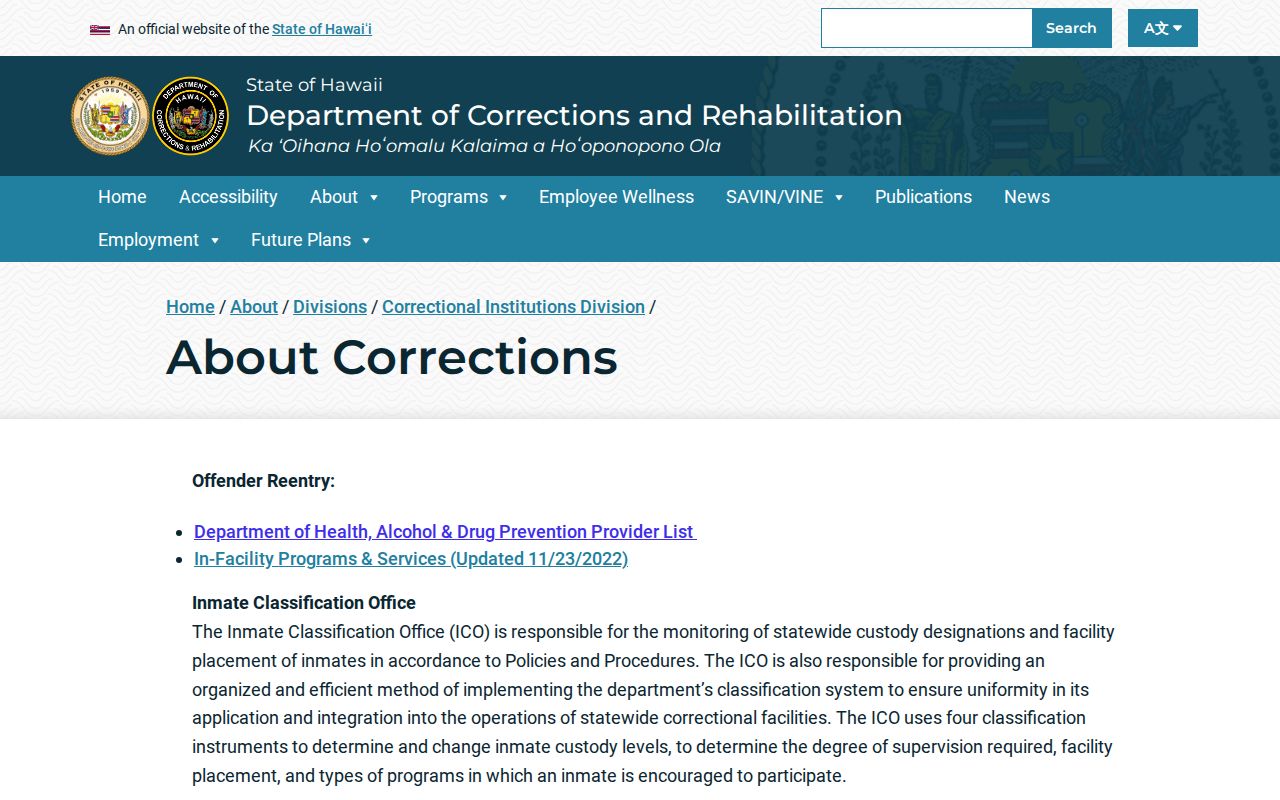
The state page confirms the public locator route and the office responsible for sentence computation, two distinct tasks.
Maui Court and Release Records
Maui court records have unusual importance because there is no official MCCC recent-release feed. The Judiciary search gateway can show bail changes, dismissal, supervised release, judgment, probation, commitment, and later orders. Those events explain legal authority.
DCR’s checklist proves implementation. A court order may not produce immediate departure if identity, documents, another charge, or a detainer remains unresolved. Conversely, a DCR transfer can end the MCCC stay without ending the court case. Pair both records before stating why and when someone left.
The Judiciary access page explains online court access and current fees.
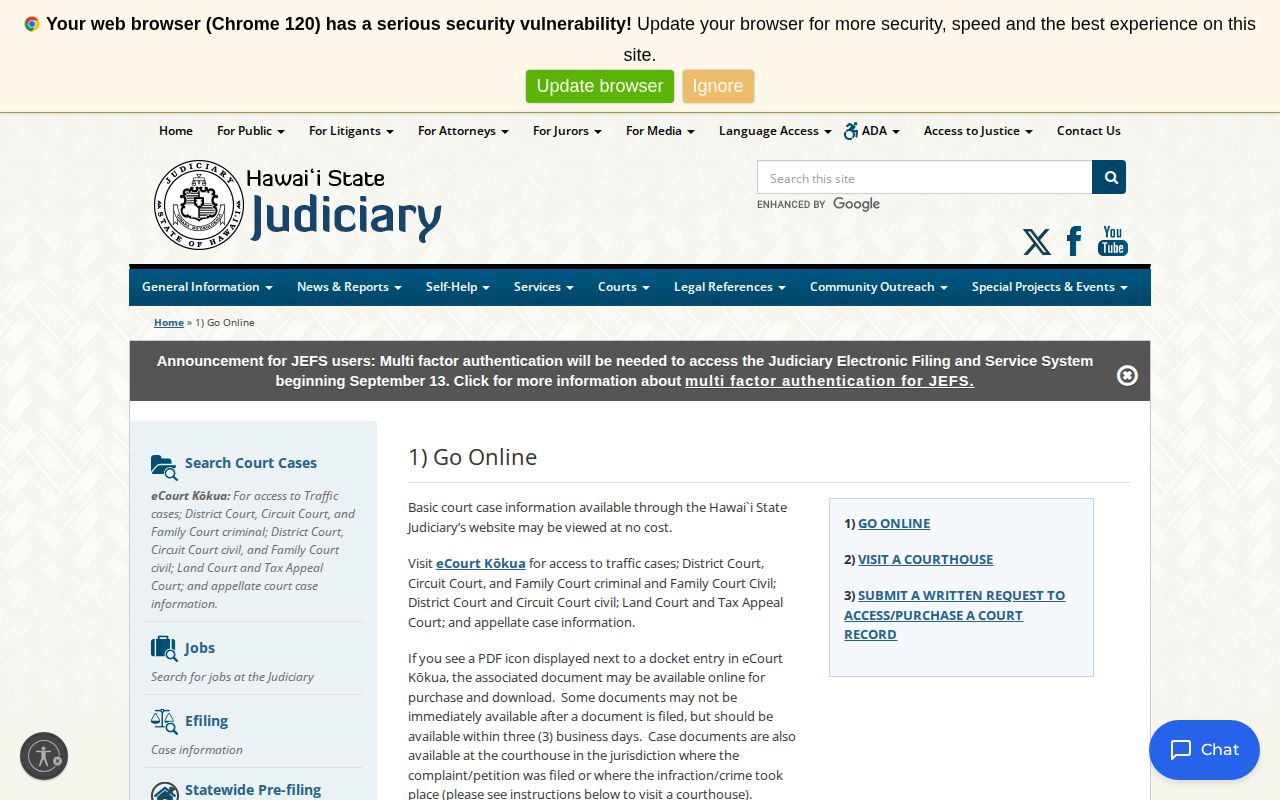
The court source is durable for the legal event, while DCR remains the stronger source for the completed physical release.
Maui County Recent Release Search
No official MCCC or DCR list shows everyone released in the last 24 or 72 hours. MCCC is state-operated, not a Maui sheriff jail with a vendor recent-bookings interface. VINELink’s app monitors one selected person and is not a release gallery or sheriff app. The Maui County 24-Hour Release List workflow reconstructs a same-day event without pretending an aggregate feed exists.
For a recent event, search the person, call MCCC or MISC, compare the three relevant dates in eCourt, and request the actual DCR release date and type if needed. Write down the time each source was checked. There is no verified online cadence, field list, photo retention window, or rolling-period definition to report.
Maui Release Supervision and Reentry
Parole and probation are different. HPA supervises parole, a conditional release from confinement under continuing state authority. The Judiciary imposes and supervises probation. There is no verified public name-based HPA directory, so use SAVIN for status and contact HPA at 808-587-1300 for routing. An absconder or suspended-parole status is not discharge.
- Parole
- Conditional release from confinement under HPA supervision.
- Probation
- A court-ordered community sentence supervised through the Judiciary.
- Discharge
- An ending event whose scope must be confirmed from DCR or HPA records.
- Time served
- Credit or completion for the specified custodial matter, subject to other cases or holds.
MCCC provides reintegration programming for sentenced felons and parole violators expected to release on Maui, including furlough-related work. DCR annual reporting also documents local transportation and reentry activity. Those resources help navigation but do not promise a result, placement, or benefit for a named person.
Getting Home After Maui Release
DCR’s FY2024 report documents MCCC transportation assistance that included bus passes. This is a useful local fact, not a guaranteed pass, fixed route, or ride for every release. Confirm transportation with MCCC, MISC, or the specific program before departure.
Maui’s island setting also separates custody site from planned return. State prisons are on Oʻahu, and some Hawaiʻi prisoners serve time at Saguaro in Arizona. Travel back to Hawaiʻi or MCCC may be an interfacility transition. It is not final discharge until the release record says so.
Maui Release Alerts and Federal Records
Hawaiʻi SAVIN offers web, phone, app, and TTY access for custody and parole status. Registration for a selected person can use available phone, text, email, or app methods, including any confirmation or private PIN step shown. DCR says registration is anonymous and confidential, yet warns users not to rely on SAVIN alone.
The BOP Inmate Locator covers federal prisoners in BOP records. A released date or “not in BOP custody” wording does not rule out U.S. Marshals, state, immigration, or community supervision. ICE ODLS is for current immigration custody and is not a comprehensive historical release archive.
Maui Release Statistics Need Context
DCR publishes weekly and end-of-month population reports, while annual reports provide broader corrections and parole performance. These are aggregate sources. They are not name-based recent-release lists and cannot prove any named person left custody.
A fall in MCCC population also cannot be converted into a count of Maui releases without a defined method. Transfers, admissions, court movements, and reporting dates all affect totals. Use the source’s stated period and population definition, and do not mix statewide parole outcomes with Maui facility departures.
Maui Release Paths Cross Islands
MCCC is both a local pretrial jail and a transition setting for sentenced felons and parole violators. Hawaiʻi’s three state prisons are on Oʻahu, and the state also contracts for custody at Saguaro. A Maui defendant can move among these facilities before community return.
The county name may describe the case, residence, or approved parole destination rather than the current prison. Search statewide. A return from Hālawa, Waiawa, WCCC, or Saguaro to MCCC can bring a person closer to Maui support, yet transfer alone does not end the sentence.
Where Maui Release Status Appears
Choose the source by the question it can answer. Current custody, completed release, legal authority, parole supervision, and federal status are distinct records.
| Question | Source | Key limit |
|---|---|---|
| Is the person currently under Hawaiʻi DCR custody or parole? | SAVIN/VINELink | Not a guaranteed historical release archive. |
| When and how did the person leave MCCC? | DCR 8219 and Offendertrak entry | Public copy may contain redactions. |
| What authorized the release? | eCourt and court documents | An order can precede physical execution. |
| Was parole approved or supervision ended? | HPA | Approval and actual release are separate. |
| Did federal BOP custody end? | BOP locator | Does not exclude another authority. |
| Is the person now in ICE custody? | ICE ODLS | No result does not prove historical release. |
Maui County Release Facilities
The facility map covers local intake, statewide prison custody, contracted mainland custody, and federal custody serving Maui cases. Each path has its own release record.
- Maui Community Correctional Center handles pretrial custody, short sentences, transition, and parole violations.
- Maui Intake Service Center provides intake, records, pretrial, furlough, and transition support.
- Maui Police Department Holding covers short-term police custody before citation, court, bail, or MCCC transfer.
- Hālawa, Waiawa, and Women’s Community Correctional Center are state prisons on Oʻahu serving Maui sentences.
- Saguaro Correctional Center holds some Hawaiʻi prisoners under contract in Arizona.
- Federal Detention Center Honolulu and the wider BOP system require federal records.
A facility departure must be classified before it is called community release. DCR, HPA, BOP, ICE, the court, or the receiving agency supplies that proof.
Preserve the name spelling, identifier, source URL, search time, and exact status wording for each check. When sources conflict, ask the owner of the underlying record to reconcile the event. MCCC or DCR owns the physical release timestamp, HPA owns its parole decision, and the Judiciary owns the court order. News and social posts can point toward an event, but they should not replace those primary records.